An Advent art contemplation on the two different portrayals of the Christ as described in the New Testament, particularly St Matthew and St Luke
This is a synopsis of an hour-long visual presentation for the 3rd Sunday in Advent this year. A sequel to the Two Marys contemplation I led in 2021, it follows the same premise but now focused on portrayals of the child Jesus. Using paintings from the earliest Christian catacombs to the High Renaissance, I explore this enigma.
There are two quite different portrayals of the Nativity in the New Testament, with two quite different moods that are reflected in the portrayals of the Christ figure throughout art history, one as Christ the king as the ruler of the world, the other as Christ the shepherd and saviour.
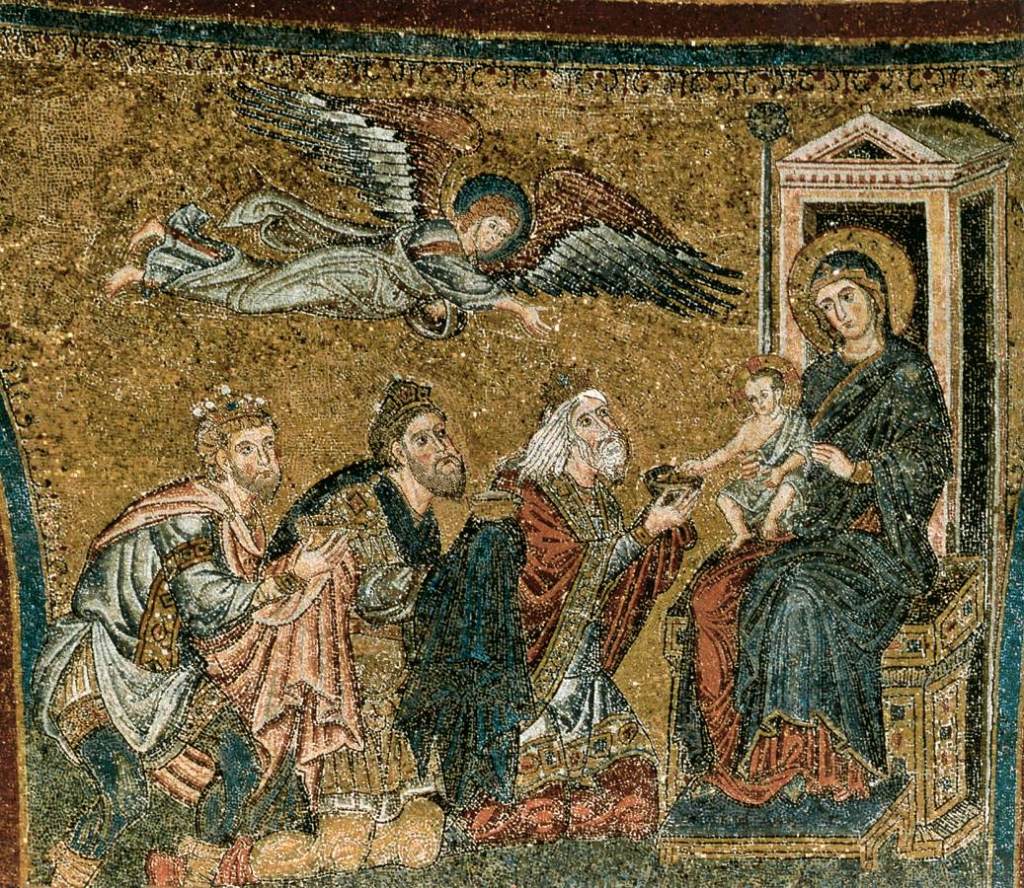
In the Gospel of Matthew, the one-liner that is the birth of Jesus is preceded by a long genealogy of the boy as the coming Messiah to show that he was indeed a son of David, a son of Abraham and followed by an angel of the Lord appearing to Joseph to forewarn him of the coming Emmanuel, which means ‘God with us’. Later, three Magi follow a star to a house in Bethlehem and find the child with Mary. They bow down and present the precious gifts of gold, frankincense and myrrh. The child Jesus is proclaimed as a king, but also a ruler who will be as a shepherd to his people. He is descended from King David and his son, King Solomon, through the father Joseph. King Herod of Judea knows of this prophesy and the birth of a messiah. This nativity is a worldly event, known to kings and prophets of the age.
In this mosaic depiction of the Matthew event, note the upright stance of the Child and his awake expression, fully conscious of his role as he stretches out a tiny hand in blessing, the same kingly gesture we observed in the Hodegetria icons.
The Gospel of Luke describes a quite different birth and a different lineage. Firstly, there is angelic vision to a father-to-be, but this time to a priest, the husband of Mary’s cousin Elizabeth, and about a different child, the prophet John the Baptist. Then the scene moves to Nazareth to the other Mary, betrothed also a Joseph, but this Joseph is descended from Nathan, the priest-son of King David. A different bloodline, one that branched away from the kingly stream to a priestly inheritance. It is clear: the Matthew Jesus is descended from Solomon, but the Luke child has his brother Nathan as his forebear.
But after this, Luke is all about the women, Elizabeth and Mary, who dominate the scene, much more of the first chapters of the gospel than in Matthew’s version. Here, the description is far longer and more detailed. Firstly, young Mary receives a visit from the Archangel Gabriel announcing her destiny as the bearer of a great individuality, the greatest, that of the Son of God. He also will receive a throne and reign over a kingdom that will last forever. Then there is the beautiful scene where Mary visits her cousin, the older, pregnant Elizabeth, and shares the mysterious event that has happened, will happen to her.
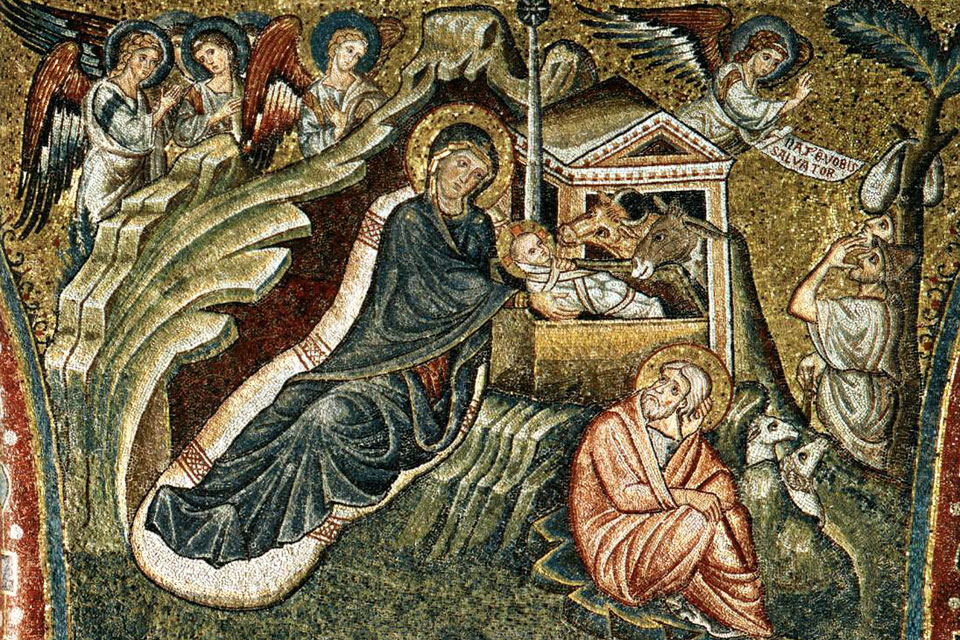
The Luke child is born also in Bethlehem, but in a manger as there is no room in a decent house for the family. Gabriel and a choir, not a star, announce the birth of a God, not to great men, but to lowly shepherds in a field watching the flock by night. Christ the Saviour is announced! And in much detail, to a few peasants and without the notice of the wise men of the age or of Herod the King.
By contrast to the kingly Child of previous image, here below, the Child is tightly wrapped and lying down, helpless and still an innocent, young baby.
In the Matthew version, the male consciousness and Messiah’s authenticity as the long-awaited saviour is foregrounded, very much a picture of an earthly destiny. In Luke, the feminine line and angelic imaginations presents a more ensouled, dream-like picture of a coming of a great priestly individuality, a saviour.
Matthew 25:31-32: When the Son of Man comes in his glory, and all the angels with him, he will sit upon his glorious throne, and all the nations will be assembled before him. And he will separate them one from another, as a shepherd separates the sheep from the goats.
1 Corinthians 15:20-26,28: For he must reign until he has put all his enemies under his feet. The last enemy to be destroyed is death.
Here (below) are representations of the two contrasting aspects of the Christ figure: on the left, the powerful Christ the Judge by Fra Angelico; on the right, Christ the Good Shepherd, a wall drawing from the early Christian catacomb wall art. One enthroned in majesty, the other a simple shepherd with a sheep slung around his shoulders.

ceiling of the Cappella di San Brizio Cathedral, Orvieto
Isaiah 40:11: Like a shepherd he feeds his flock;
in his arms he gathers the lambs,
Carrying them in his bosom,
leading the ewes with care.John 10:14-18: I am the good shepherd; I know my sheep and my sheep know me. Just as the Father knows me and I know the Father—and I lay down my life for the sheep. I have other sheep that are not of this sheep pen. I must bring them also. They too will listen to my voice, and there shall be one flock and one shepherd. The reason my Father loves me is that I lay down my life—only to take it up again. No one takes it from me, but I lay it down of my own accord. I have authority to lay it down and authority to take it up again. This command I received from my Father.”

3rd Century, Catacomb of Domitilla
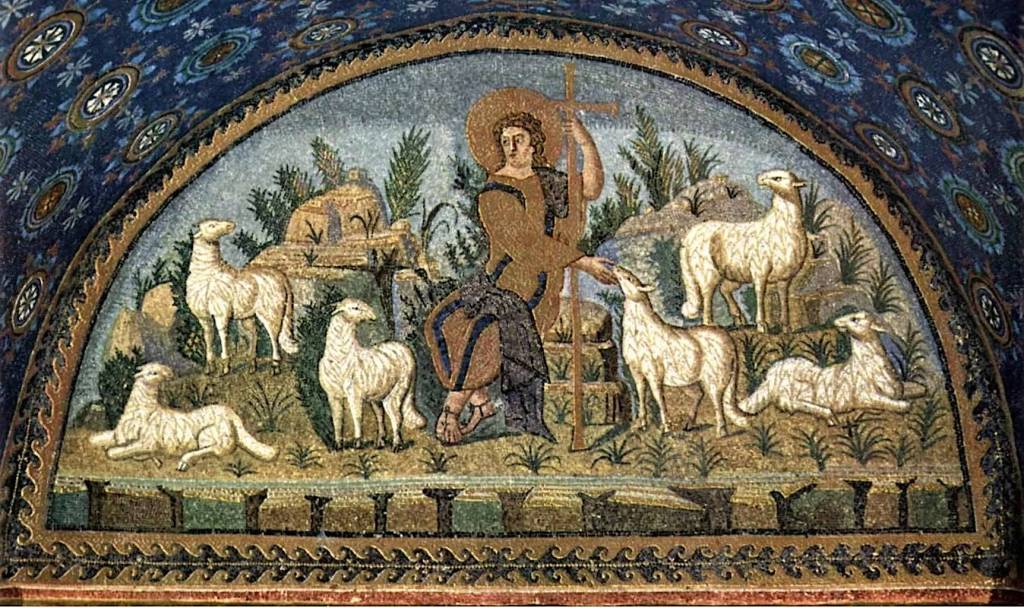
I can’t resist also including this beautiful mosaic from Ravenna of Christ as Shepherd on his throne of stones.
When the boy Jesus turns twelve, Luke tells us that during a visit to Jerusalem at Passover, the boy could not be found when the parents left to return home. Returning to Jerusalem, they found him teaching in the temple surrounded by the learned men of the temple and all were amazed at the wisdom coming from this young boy. And so we can now add ‘teacher’ to the Christ’s being.

Then we can’t forget Christ as the healer, the bringer of miracles.
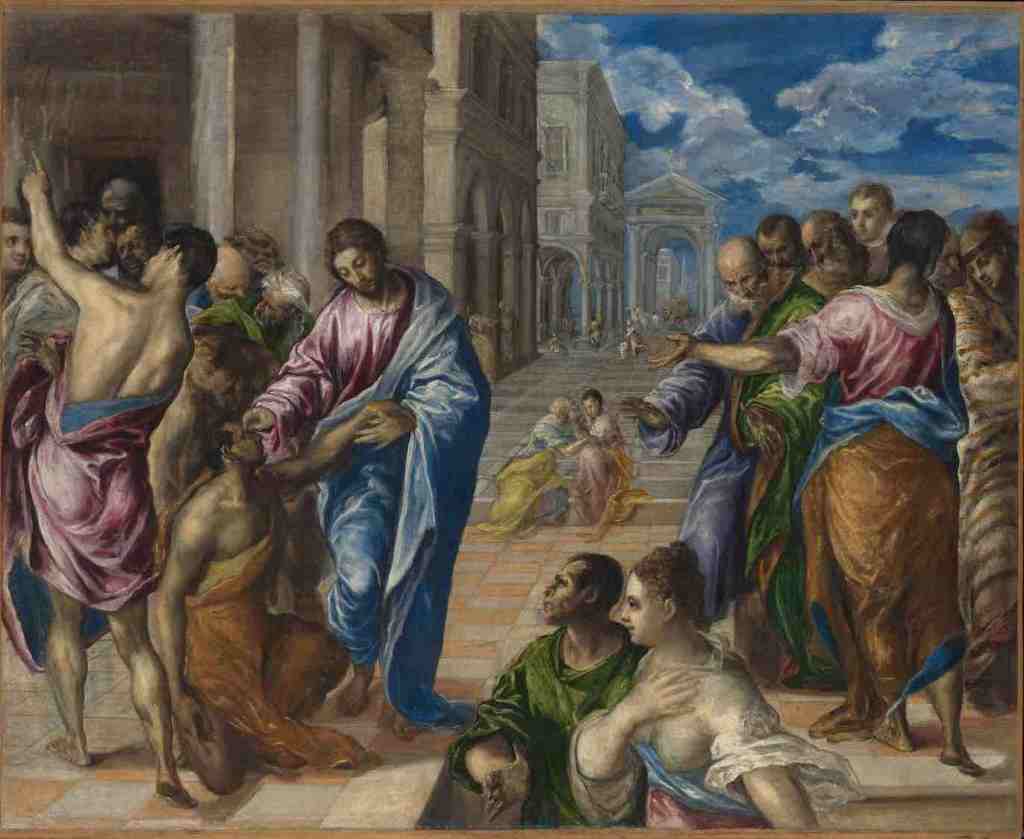
So what does this tell us about the individuality of the Christ that is not already known and documented? Two contrasting beginnings that suggest some mystery at work, more than simply saying Luke and Matthew told stories to fit their worldviews. There were qualities of soul in the whole mood of each version that are quite at odds with the other and yet seemingly come together in the figure of Christ: signs of nascent powers in biography of young Jesus, as portrayed in the Gospels, and later in Paul’s letters. But it is in the artistic interpretations that we observe the full range of representations of the individuality of the Christ figure, as revealed after his death and resurrection. A kingly, majestic figure of authority who is both judge and teacher, but also priest, healer and humble shepherd of his flock. There ar
What might this mean?
As stated in the Two Marys post, Rudolf Steiner represents these as two different streams from the past, a kingly stream from Solomon and that of untouched purity and sacrifice, the priestly stream from Nathan, coming together to create the perfect vessel for the Christ, who embodies both streams, but transforms and transcends them.
In this post, I’ve presented only a tiny, tiny selection of images. I encourage you to look for more, and choose one as your Christmas contemplation, whichever personification speaks most strongly to you. It is through the artists that secrets are revealed: “In the creations of the artist there will appear to us the traces of her soul experience in the cosmos.” Too often art is dismissed as the artist’s fantasy, or symbolic meanings only, not to taken with the seriousness of written texts and historians. But art is bridge between this world and our spiritual home, unseen perhaps by us, but revealed in fragments to the artists.
O Wisdom
The O Antiphons
O Adonai
O Root of Jesse
O Key of David
O Star of Morning
O King of the Nations
O Emmanuel
Come, Save Us
References
Bock, E. (1997). The Childhood of Jesus: The Unknown Years. Floris.
Bernard Nesfield-Cookson, B. (2005) The Mystery of the Two Jesus Children (And the Descent of the Spirit of the Sun)
Steiner, R. (2013). The Fifth Gospel: From the Akashic Records. Rudolf Steiner Press.
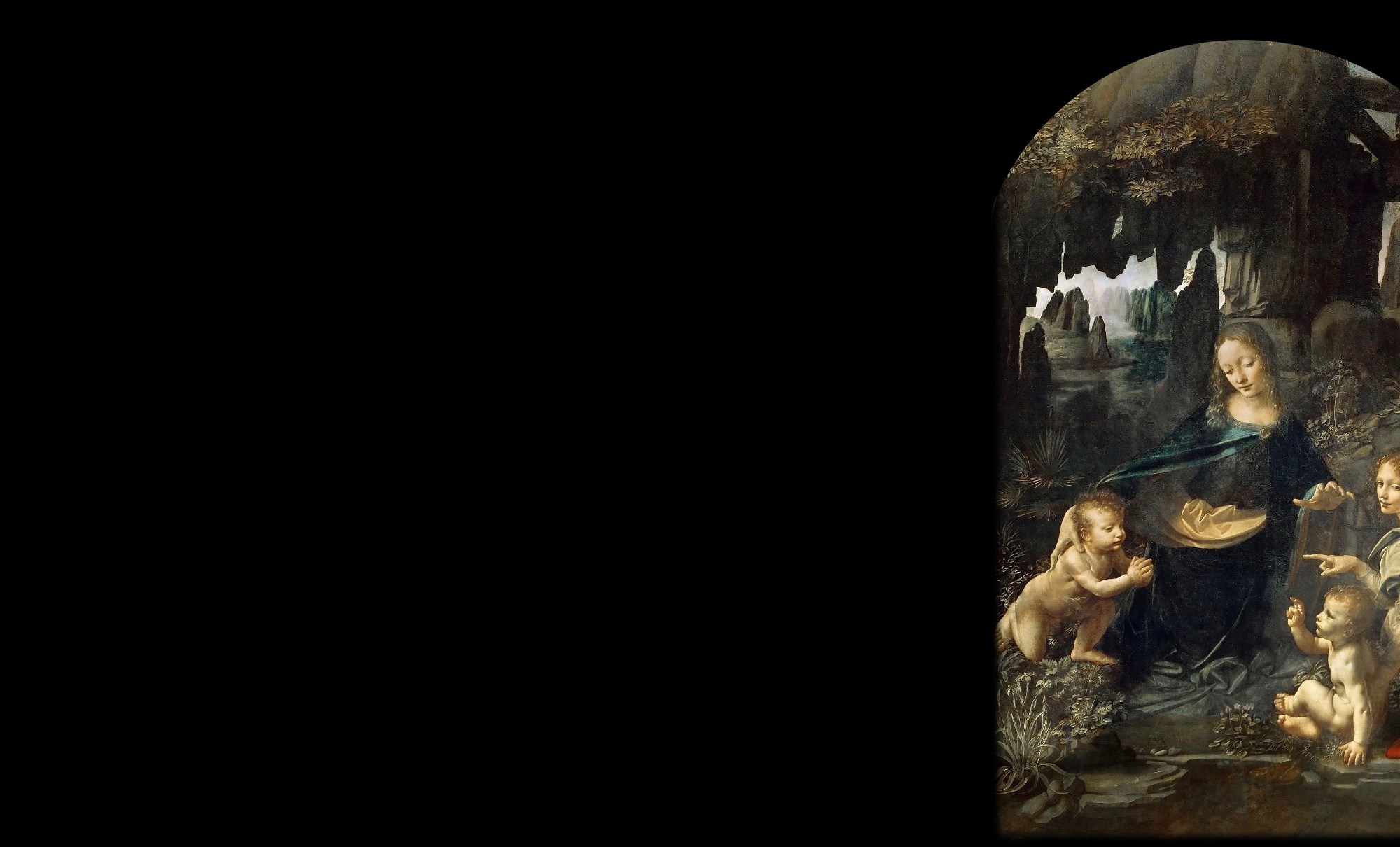
Feature image: Virgin of the Rocks, Louvre Museum, by Leonardo da Vinci
 Painted Space
wow!! 31What can water science contribute to our understanding of creativity?