
Exploring Schwenk’s understanding of thinking as a dynamic water process
The activity of thinking is essentially an expression of flowing movement. Only when thinking dwells on a particular content, a particular form, does it order itself accordingly and create an idea. Every idea – like every organic form – arises from a process of flow, until the movement congeals into a form.
Theodor Schwenk
Introduction
Goethean phenomenology is a research methodology best known in connection with the field of Natural Sciences and the observation of Nature. Fundamental to its approach is seeing the phenomenon of Nature as whole, where wholeness comes to presence within its parts (Bortoft 1996). But the human being is also a phenomenon whose wholeness can be seen within our parts. We ourselves are intrinsically connected with Nature, though in our modern consciousness tells us we experience ourselves as separate from it. Learning to see the human being through the phenomenological lens, then, can lead us into a deeper, more living connection with Nature, not just in our feeling life, but in our thinking. And when the human being begins to think, to really think and feel an idea living within in himself,”he looks upon himself and nature as being one whole[1].” (Rudolf Steiner 1985).
To experience an idea living within us is not such as common occurrence. And that’s the problem – too many people think that thinking is something abstract and separate from our living experience. Or maybe they believe that spiritual thoughts come to us as gifts from heaven without much connection to our own ideation ability. Where do new ideas come from? I once asked this questions at an Anthroposophical event and was told “from the spiritual world, of course”, as if it was that simple. This is not necessarily untrue, but as a careful study of the experience of the thinking process can show, the liveliness of the human mind, even how we experience our thinking plays a part in this.
But first, what is phenomenology? It is known generally known as the study of the ‘lived experience’, but more precisely, it is the study of the structures of our consciousness. To put it another way, phenomenology opens the way to understanding our consciousness of our experiences. And that includes our experience of our cognitive processes.
I first became fascinated with how we think when I was studying information science at the University of Technology Sydney, 20 years ago. I soon became aware that I had an artist’s mind in a cognitive science world. As an visual artist, I was intrigued by the prevailing image of creative thinking as static, segmented and unilinear, having experienced it as anything but this. Questioning such models led me to challenge this approach in my doctoral research on the nature of consciousness during the creative act. But I was only able to achieve this by using phenomenology as my methodology and taking an interdisciplinary approach that straddled philosophy, psychology, computer science, visual arts, natural science and even contemplative practice, in order to approach thinking from a human-centred perspective.
In this brief article, I will share here a little of the nature of this research, with this excerpt from a paper I wrote for a conference[1] in 2019, based on my research into the origin of generative ideation.
Thinking as an process of flow and resistance

This imaginative metaphor for thinking (epigram above) from water scientist Theodor Schwenk was inspired by his qualitative investigation into the nature of natural water flow. His studies revealed that the structure or form of water in the natural environment has an intrinsic ebb and flow that is more than simply a flow of energy; that it has expressive, curvilinear gestures that meander, spiral and oscillate and yet has a rhythm that follows a law towards the spherical shape of the water droplet.
But his analogy of water flow with thinking is more than just poetic; he based this aesthetic imagery on his meticulous experimentation and observation of natural water processes, imbuing empirical methods with metaphoric imagination. The foundation of his concept is that the activity of thinking has the same meander gesture as water flow. In water, natural forms arise out of weaving strands of flowing movement. They are shaped by water’s intrinsic dynamic in interplay with external constraints – rocks, twigs, the banks of a river – that act as resisting forces, resulting in one complex, multi-stranded, dynamic movement. In the same way, ideas, i.e. thought forms gradually arise in the process of our thinking, says Schwenk, due to the tension that arises through a similar “dissolve and bind” (1996, p. 97) process.
This presents us with a phenomenological picture of the thinking process as an oscillating, ever-evolving stream of flow and resistance that embodies both order and chaos, continuity and discontinuity. Thinking, when in full flow, should be experienced as this dynamic, living, streaming movement, active in our inner life.
About Theodor Schwenk
Theodor Schwenk was a pioneer in water research, perhaps best known for his unique book Sensitive Chaos (1996, originally published in German in 1962) on water as the universal bearer of living, formative processes. Sensitive Chaos was written in the tradition of Goethean phenomenology, which views Nature as ruled by a single unifying principle, apparent in all movement and form. Schwenk’s highly readable book, illustrated with many photos and drawings from his meticulous research, reveals these unifying forces that underlie all living things can be observed in such phenomena as the flight of birds, the formation of internal organs such as the heart, air patterns in musical instruments, the formation of river deltas, and in weather patterns. He was one of the first to bring the concept of ‘water consciousness’ to environmental studies and founded the Institute for Flow Sciences to further advance the scientific study of water’s movement and its life-promoting forces. His original insights into methods for analysing water quality have been used for cleansing polluted and ‘dead’ water.
However, his conception of human thinking as a process of flow and resistance, introduced in the latter part of his book, cuts across all disciplinary boundaries to revolutionise the way we think about thinking, and, just as importantly, the way we can experience it, when thinking is enlivened with conscious perception and inner activity.
Natural water flow as an image of thinking
Therefore, we speak of a capacity to think fluently when someone is skillfully able to carry out this creation of form in thought, harmoniously coordinating the stream of thoughts and progressing from one idea to another without digression – without creating whirlpools.
(Schwenk 1996, p.96-97)
Conceptualising thinking in terms of fluidity or flow is not unique to Schwenk: we are all familiar with the phrases like “the flow of thought” within “the stream of consciousness”. But Schwenk deepened and extended these metaphors when, through his qualitative water experiments, he demonstrated that Nature is one living being, and human thinking, when enlivened through heightened perception and immersive observation, connects us to this living being of Nature. Then we become aware that we are a part of this living being.
Schwenk’s descriptive, ‘lived experience’ understanding of how we think and process our ideas demonstrates a far more integrated understanding of human thinking than traditional science’s dualist stance to the cognition (and indeed, the human being itself), which aims to explain cognition in isolation from general human experience, separating thinking into types, such as intuitive vs. logical, or critical vs. creative. Further, such dualistic approaches characterise the structure of thinking as a step process in a unilinear process of thought.
By contrast, Schwenk’s image of thinking has a multi-string ‘thickness’, which enables the dynamic, continually recursive interplay between the two opposing forces of flow and resistance. And Schwenk posits that the quality of the thinking’s movement as important as the structure itself. His holistic position sees cognition as part of human experience, not distinct from it, where the human being is dynamically interacting with the world through perception, cognition and experience, in ways that cannot be abstracted into theory.
Dynamic thinking is creative thinking
“As long as a person does not feel the working and creating of an idea, his thinking remains separate from nature”.
(Steiner 1985)
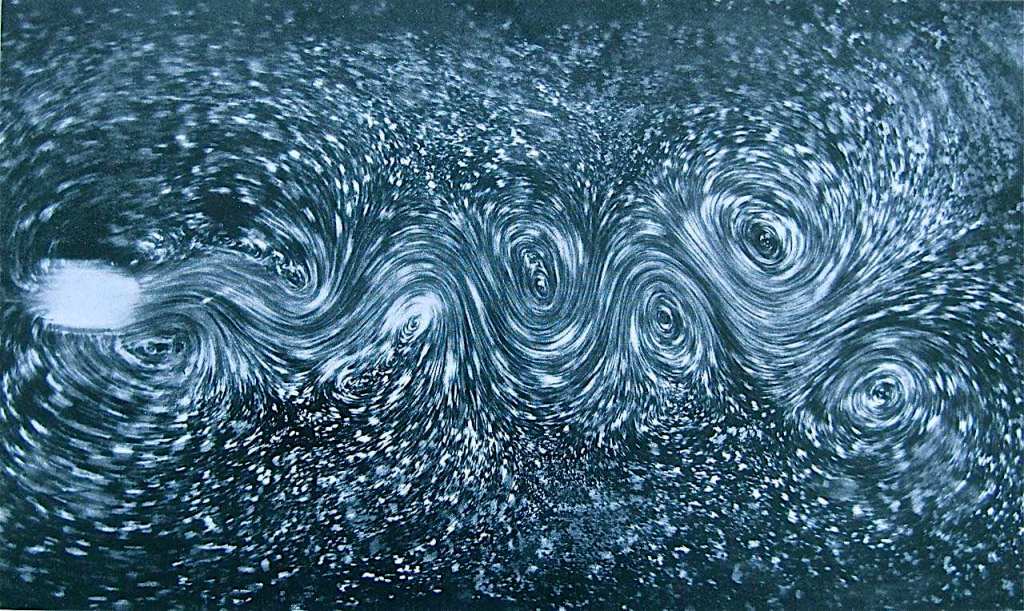
The image in Figure 2 is an image of water flow generated under controlled conditions, where oil is dropped into the water, so the flow movement can be clearly observed; then a pencil, acting as a resistance force, is drawn through the water several times, from left to right. The central meander form is clearly visible, as are the vortices created by the repeated dynamic of the moving pencil. Schwenk compares this movement to enlivened thinking, where thinking is not a straight line, but a dynamic movement, fluid, flexible, mobile, encountering and engaging with any hindrances it meets. Fixed ideas can arise when there is too little dynamic flow, as in the way stagnant pools arise from sluggish water flow; whereas thinking that meets few hindrances can quickly become shallow, like a “a flight of ideas” (p. 96). When the thinking avoids these two extremes, it then “congeals into a form” (1996, p. 96-97), like the vortices that are formed out of the tensions in the flow of water. At the heart of these vortices is a hollow space. In thinking, such spaces are where ideas can arise; “Like water” says Schwenk, “thought can create forms, can unite and relate the forms to one another as ideas; it can unite but also separate and analyse” (p.96).
Schwenk described water as “the creative substance for the generation of all forms” (Wilkens, Jacobi & Schwenk 2005, p.26). It is implicit, then, in his understanding of thinking as flowing meander process, that the activity of thinking is also inherently creative – if it is enlivened. This then presents us with an experiential picture of thinking as a dynamic multi-stranded stream of ebb and flow that that intrinsically generative, out of which new ideas can arise.
Here, thinking is experienced as a coming-into-being phenomenon.
Schwenk’s contribution to our understanding of where new ideas come from
Thinking that cannot enter deeply enough into every detail becomes a flight of ideas, torn along as though by an invisible torrent in which it can create no permanent forms. On the other hand, thinking that becomes solidified in fixed ideas remains a captive of form, without being able to develop towards further possibilities.
(Schwenk 1996, p.96-97)
If the emergence of creativity is seen a coming-into being-process, as my research suggests (Campbell 2018), then what Schwenk is intimating is that dwelling repeatedly on a thought, always deepening the process, can, in fact, lead to the generation of a new idea.
However, the analogy he conjures, with his description of thinking as water flow (see the epigraphs), does not actually indicate how this “creation of form in thought” (1996, p. 96) actually occurs. And it should be noted that Schwenk derived this analogy from his phenomenological study of water dynamics, not from the study of the human experience of thinking itself. He makes the connection by way of the Goethean principle of a unifying whole, always seeing the whole through the parts. And although flow and resistance are apt descriptions of the cognitive process, the human experience of the process of new ideas arising through repeated dwellings, appears more complex and subtle than his analogy can encompass.
However, a closer reading of earlier parts of Sensitive Chaos reveals a basis for his assertion. Firstly, he describes water as a creative substance and as the universal bearer of living, formative processes. By analogy, active thinking that embodies living formative processes must also be inherently creative. This references such holistic theories of cognition where thinking is one intrinsically unified, active process (Bortoft 1996), and one that assumes creativity is inherent (Abel 2009). But then it is Schwenk’s description of the vortices that arise in water flow from the interplay of flow and resistance that provide an answer to how a thought ‘form’ appears; how a hollow space arises out of the undulating recursive movement; and how a separate space “with a life of its own” (p. 41) is then created within the flowing movement.
Just as water flow creates spaces for the potential of impulses or forces in water, so the dynamics of repeated cognitive dwelling can generate the kind of openings conjectured by creativity researcher Paul Carter (2004), physicist Arthur Zajonc (2009) and philosopher Günter Abel (2009) as potentiality spaces for creativity. Perhaps it is the destabilised nature of this space, as both Carter and Zajonc suggest, (rather like that of the vortex created in water), that opens the way for new ideas to emerge. Nevertheless, the creative insights that potentially emerge from this process come into being as a result of friction and chaos generated by the opposing forces that created these spaces in the first place. Schwenk’s imagination of thinking as water flow appears to assume this knowledge.
With a closer study of Schwenk’s scientific work, this image could be ‘fleshed out’, so to speak, but it is beyond the scope of this article to do more than outline the precise process by which creativity emerges out of flow and resistance. However, it points to the increasing importance of looking beyond traditional disciplinary boundaries when researching complex phenomena such as creativity and human potentiality. Taking an interdisciplinary approach to research cannot be underestimated. If one wants to understand the complexity of the human being in our wholeness, then emergent methods such as phenomenology, which pushes beyond the boundaries of what is known and what is certain, are required.
We see how Schwenk’s imaginative approach to understanding water phenomena has produced a metaphor for thinking that has real value for understanding the creative process. This is not to suggest the metaphor itself should be used as a model of the creative process, so much as to point to the value of seeing cognition as a dynamic force rather than a linear progression and to recognise its generative, coming-into-being nature as well as its productive side. For this reason, Schwenk’s work and its significance for our understanding of where new ideas come from go beyond the metaphor, and beyond natural and environmental science research.
It has implications for understanding of the intrinsically creative potential of human thinking itself.
References
Abel, G. 2009, ‘The riddle of creativity: philosophy’s view’, in P. Meusburger, J. Funke & E. Wunder (eds), Milieus of creativity: an interdisciplinary approach to spatiality of creativity, vol. 2, Springer Netherlands, Dordrecht, pp. 53-72.
Bortoft, H. 1996, The wholeness of nature: Goethe’s way toward a science of conscious participation in nature, Lindisfarne Books.
Bortoft, H. 2012, Taking appearance seriously: The dynamic way of seeing in Goethe and European thought, Floris Books.
Campbell, F. C. 2018, ‘Flow, resistance and thinking: a phenomenological study of creativity’ (doctoral dissertation), Open Publications of UTS Scholars, accessed at http://hdl.handle.net/10453/129435
Carter, P. 2004, Material thinking: the theory and practice of creative research, Melbourne University Publishing, Carlton, Vic.
Runco, M.A. 2014, Creativity: theories and themes: research, development, and practice, 2nd edn, Elsevier Science, Burlington.
Schwenk, T. 1996, Sensitive chaos: The creation of flowing forms in water and air, 2nd edn, trans. O. Whicher, J. Wrigley, J. Collis, W. Roggencamp, Rudolf Steiner Press, Forest Row, East Sussex.
Steiner, R. 1985(1918), Goethe’s World View, Rudolf Steiner Nachlassverwaltung, Dornach, Switzerland
Wilkens, A., Jacobi, M. & Schwenk, W. 2005, Understanding Water: Developments from the work of Theodor Schwenk, trans. D. Auterback & J. Greene, Floris Books, Edinburgh.
Zajonc, A. 2009, Meditation as contemplative inquiry: When knowing becomes love, Lindisfarne Books Great Barrington, MA.
[1] Listening to our Time, Speaking to the Stars, Emerson College, Forest Row, 7-11 August 2019.
Feature image: Water Flow Wallpaper Set is created by ivv79.
 Painted Space