
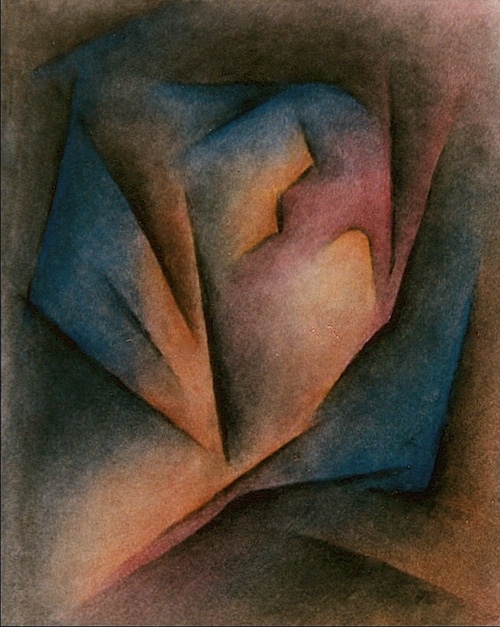
The temple of higher cognition is not surrounded by walls,
Herbert Witzenmann[i]
it is protected by the colours of the soul:
of silence that listens to the spirit,
of forgetting that casts off external impressions,
of remembering that is borne upon welling streams of creative power.
Art is a wonderful medium for self-expression, for exploring our creativity, for fostering imagination and for its benefits to our mental health and wellbeing. We recognise its importance as much for understanding history and culture as we do for the joy and pleasure it brings to our lives. But none of this touches on the deeper meanings that art can hold for us.
In the act of creating, creator and the creation disappear and become one. We experience ourselves as something other than our everyday taken-for-granted self. Hints at unknown and unseen forces in and around us, opening us to the potential for new things to arise, new insights to reveal themselves. In my research on creative process[ii], one of the participants described this as the closest she came to a spiritual experience:
I found I was working in another space, a creating space.
The mind wasn’t judging, but rather, wondering.
Spirituality and art meet in the act of creating.
The Austrian philosopher Rudolf Steiner (1861–1925) intended the artistic to be central to the pursuit of spiritual investigation he named ‘Anthroposophy’, just as he believed creativity to be central to what it means to be human. Yet access to the spiritual is not simply a given today. In our materialistic age, the soul needs awakening to its inmost needs, perhaps far more than we realise. The path to the spiritual needs to be actively cultivated with our whole being, not just our head. The arts play a role here beyond the aesthetic.
Let us consider art as something more than a means for self-expression, transformational and joyful though this may be for us. Let us appraise art as a spiritual practice, where creativity is the door that opens us to this practice.
Art is a bridge
There are three possible relationships between art and the spiritual: artistic creations can reveal spiritual insights; art can induce forms of encounter that are alike to spiritual experiences; and such spiritual experiences can inspire artistic creation.
What does it mean to have a spiritual experience? Let’s characterise ‘spiritual’ as having a sense of a world beyond the material; a transcendent dimension of reality where we can achieve a deeper relationship with the meaning of life; a place where the existential questions we carry about our self and our purpose of being can find resonance; or where we have encounters of ineffable significance.
Spiritual experiences can be transformative. They change the way we relate to the world around us and to ourselves, and can act like a compass, orientating us in a life that seems increasingly uncertain and demanding. When we can feel ourselves to be greater than our everyday self, we may even have a sense of our ‘back space’ opening up like a window through which the spiritual world shines upon us.
Art, then, can be a bridge to the spiritual experiences, to awakening to the spiritual dimensions of our daily life. “If you realise that art always has a relation to the spirit, you will understand that both in creating and appreciating it, art is something through which one enters the spiritual world[i]”, says Steiner. When we work with art with this understanding, then we step out of our skins and take part in cosmic life.[iii]
Art is an expression of cosmic life
Art is a bridge that leads both ways. Just as it is a path to accessing spiritual insights, art can communicate to us, through artistic practice or art contemplation, glimpses of the spiritual realities. Steiner tells us that when we work with the true qualities of colour, tone, and word, then ‘in artists’ creations we shall meet, as it were, traces of the artists’ experiences in the cosmos.’[iv] However, as in Steiner’s time, it is common today to place more emphasis on an artwork’s content, the artist’s biography (interesting though this may be) or the concept behind it, than on its actual artistic qualities that can reveal such experiences.
Qualities come from the interior. They are responses or expressions that arise in our inner life and are outwardly embodied in the world. They are ‘what things seem to us’. Think of painting: qualities such as ‘redness’ can only be understood by direct apprehension of its true nature, by our inner experience of the phenomenon, and how we respond to it. Words can only skirt around our feeling for ‘redness’. A colleague recently shared, that after three years of art therapy training, her students still struggled to describe their relationship to painting and colour. I suspect this is because colours are soul encounters that belong to those ineffable moments that words cannot fully encompass. Yes, we perceive them in the outer world, but we ‘know’ them through how they work upon our souls. Colour is a language of the soul. “Whether he creates as a painter or just lives in and enjoys a painting, it is a soul event”.[v] When we approach the true nature of colour, the soul is within the spiritual. We have the experience of the soul moving freely about in the cosmos.
By learning to unite ourselves with the inner essence of the laws of colour, form, tone and word, art opens the way to true spiritual encounters.
Art works upon us
Art works upon the human soul to awaken in it a feeling, a deep feeling, for the spiritual realities of what is portrayed.
For the painters, Rudolf Steiner created a substantial portfolio of drawings, pastel sketches, and paintings to stimulate enlivening to the abstract materiality that has overtaken the visual arts in modern times. Many of these motifs were destined for the interior of the First Goetheanum, with the purpose of helping us find a new relationship to art as a basis for spiritual awakening. By working imaginatively with these motifs, then, we can then approach an experience of the inner truths of reality. Not only through the content but through the inward experiencing of them. By working actively, again and again, with their forms and processes, by experiencing their qualities, we can refine and order our soul body, make it more permeable, so our soul is more receptive to receiving those spiritual insights that lie deep in our souls.
The practice of art then strengthens our inner forces. By bringing inner mobility, inner breathing and opening the soul to new ways of seeing and experiencing the world, we are working with the core attributes of creativity[v]. Working on your creativity then becomes working on yourself: you are shaping yourself while shaping the artwork. You and the artwork become one. Arthur Zajonc might say that the painting is an afterimage of your experience of painting, in which you approach the spiritual being that is waiting to be revealed.[vi]
This is the potential outcome Steiner foresaw for his new artistic impulse: a practice that develops a new way of thinking and feeling in both the creator and the observer, which in turn becomes an encounter with a spiritual reality[vii]. Art then becomes a training for the refining and ordering of the soul life, a schooling for the soul. It becomes a spiritual practice.
Art as spiritual research
Artistic creation is, therefore, both a place for encountering the divine and a vehicle for expressing these encounters. Further, the spiritual meanings we discover and generate through art have practical consequences, such as exercises and practices which embody and support our creative process. Spirituality is always linked to practices and exercises[viii]. Artistic creation, when practised in as structured yet mobile and imaginative exercises, becomes an investigative process that increases our knowledge of both art and its spiritual dimensions. The ongoing process of working repeatedly with such exercises opens up new ways of seeing and experiencing art, and we learn to grow beyond ourselves.[ix]
Art then becomes a research tool that guides our spiritual practice. By bringing ourselves closer to the inner being of art, as directly as possible, through repeated immersion into structured exercises concerning colour, tone, form, or word, we gradually transform our soul body and strengthen our ‘I’. This can prepare us for the uncertainties of the future coming to meet us. “All desire to withdraw, to protect oneself from the influences of unavoidable world-karma, emanates from weakness…. Our task is to strengthen the soul by permeating it with the impulses that come from the Spirit and spiritual research, so that it is armed against the influences of modern life”[x]..
It’s in that convergence of spiritual people becoming active and
active people becoming spiritual that the hope of humanity now rests.Van Jones
Art is an inner need
The practice of art is not just for artists or those talented in artistic expression. Don’t avoid creating art because “it doesn’t look like what I want it to”, a frequent cry in workshops. Art is not only about creating beauty or satisfying results. Just as creativity is an inherently human attribute, so the human soul longs for the artistic. The spiritual world lives in the artistic, as a “living, colourful, form-bearing weaving and being’ reality”[xi]. Therefore, working with the arts, out of the arts, must become central to our way of engaging with Anthroposophy.
Anthroposophy should not just be taken in as concepts or theories, states Steiner, which has a hardening effect on the soul, but be experienced by whole human being. Working artistically with the concepts of Spiritual Science we make them experiential; we approach an inner experience of their truths. Steiner gives countless indications for how we can work with painting, drawing, sculpture, speech, music, and movement in such a way that enlivens our understanding of Anthroposophy.
The First Goetheanum was not just a place where a new artistic impulse was born, but an expression of Anthroposophy itself. Everything that is Anthroposophy was expressed in its artistic formation. It was meant as a signpost for our future: without the development of an artistic approach to Anthroposophy, it will remain just concepts, “impertinently rigid, philistine and horribly scientific formulations”[xii].
Therefore, becoming artistic is an inner need of Anthroposophy. It can act as a cultural therapeutic. And without the artistic element, Anthroposophy cannot go into the future. I will close with this quotation from Steiner about Anthroposophy if not imbued with the artistic impulse:
In an inartistic atmosphere it goes short of breath; only in an artistic element can it breathe freely. Rightly understood, it will lead over to the genuinely artistic without losing any of its cognitional character.[xiii]
Rudolf Steiner
This article was presented as a lecture on 18th November 2023 at the Conference of the Visual Arts Section – Expert Conference for Visual Artists, 17-19 November 2023 November, Dornach.
Endnotes
i. Herbert Witzenmann, Beppe Assenza (1978), Verlag Freies Geistesleben, Stuttgart.
ii. Fiona Campbell, Flow and Resistance in Thinking: A Phenomenological Study of Creativity (2018).
iii. Rudolf Steiner, Colour (2013), Rudolf Steiner Press.
iv. Rudolf Steiner, ‘Lecture III’, The Arts and their Mission, 2 June 1923, Dornach, CW276 & CW 291
v. Rudolf Steiner, ‘Moral Experience of the Worlds of Colour and Tone’, Art as Seen in the Light of Mystery Wisdom, 1 January 1915, Dornach CW 275.
vi. Arthur Zajonc, Meditation as contemplative inquiry: When knowing becomes love (2009), Great Barrington, MA: Lindisfarne Books.
vii. Christiane Haid, ‘Creating Forms as Expression of our Inner Life,’ SBK Newsletter October 2020.
viii. Carlos Miguel Gómez-Rincón, ‘Art as a spiritual practice. The interplay between artistic creation and spiritual search in seven Colombian artists’ (2023), Journal for the Study of Spirituality.
ix. Brent Dean Robbins, ‘New organs of perception: Goethean science as a cultural therapeutics’ (2005), Janus Head vol. 8, no. 1, pp. 113-26.
x. Rudolf Steiner, ‘Technology and Art’, Art as Seen in the Light of Mystery Wisdom, 28 December 1914, Dornach, CW 275
xi. Rudolf Steiner,’ Lecture III’, The Arts and their Mission, 2 June 1923, Dornach, CW276 & CW 291
xii. Ibid.
xiii. Ibid.
Feature image: Black Study, Fiona Campbell 1996
 Painted Space