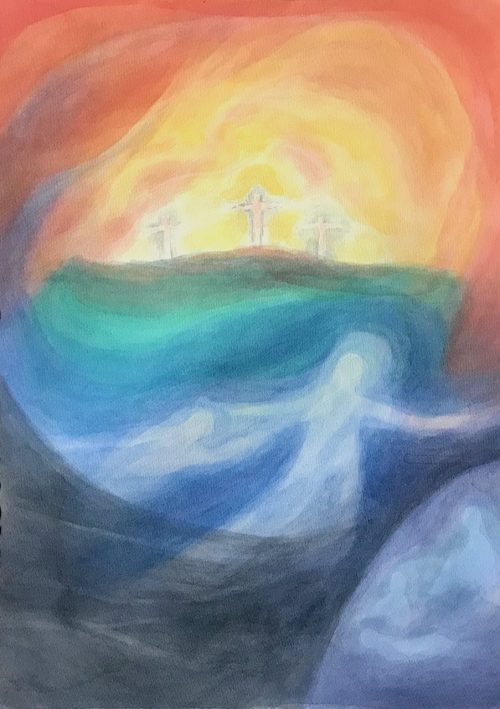
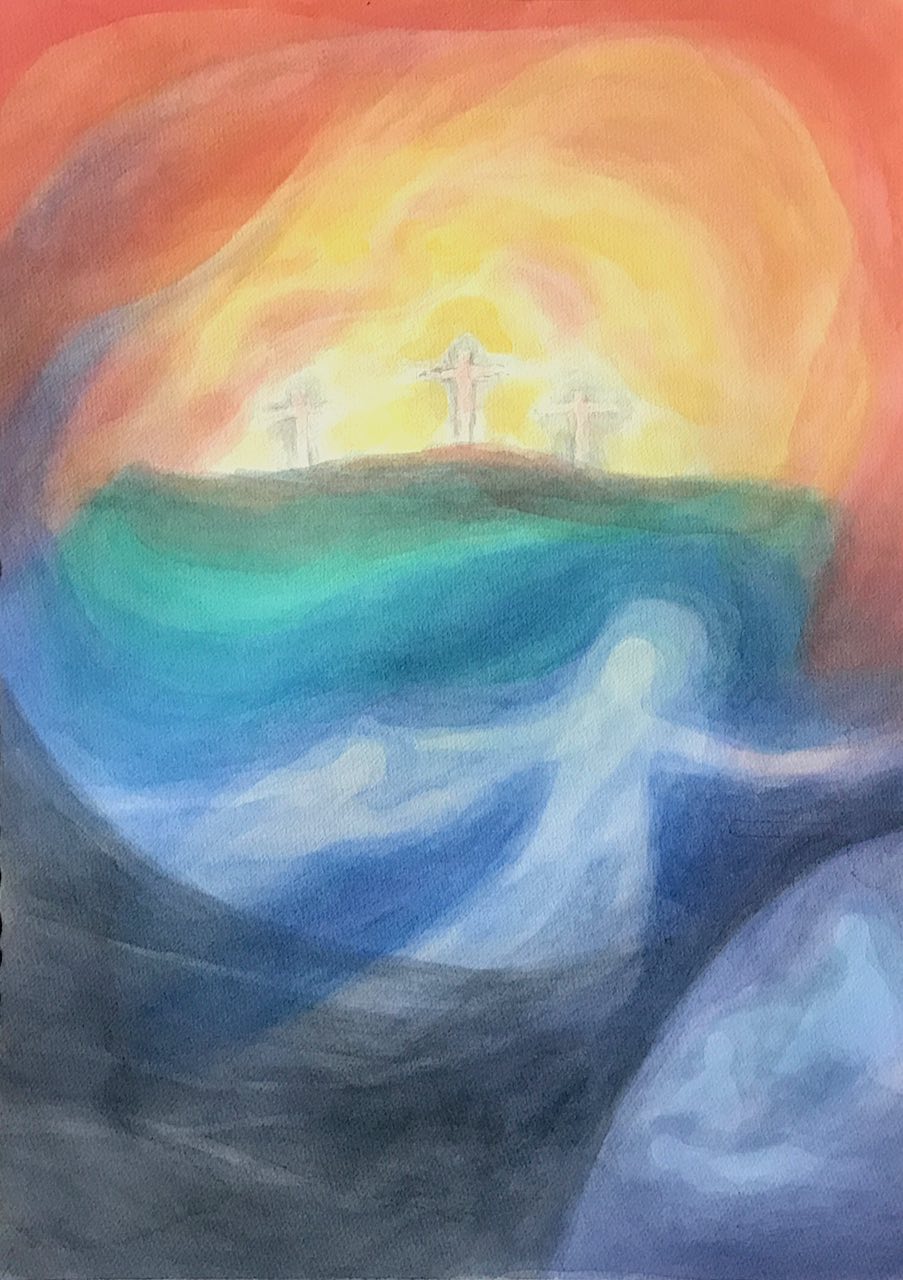
” In death He became the helper of the souls of the dead who had lost their divine nature.”
from the Act of Consecration of the human being
A image to meditate upon or, even better, to paint or draw during the Easter festival.
Easter (Three Crosses) portrays an unusual scene in the Easter tableau: Christ in the Underworld, redeeming the souls of the dead on Black (Easter) Saturday. This watercolour motif by Rudolf Steiner, interpreted here by the writer, takes us beyond the Crucifixion, into a world of rainbow colours, an utter polarity to the dark colours and muted tones in most portrayals of the Easter event in traditional paintings by the Masters of Western art.
According to Emil Boch, the secret of the words by Jesus Christ on the cross: ‘It is finished’ can be found in the understanding that Christ’s sacrificial deed does not reach its fulfilment on the Cross, but in Christ’s overcoming of Death by uniting his soul with the Earth after His crucifixion, a sacrifice he accomplishes for all earth existence. In the underworld of Death, on Holy Saturday, Christ walks amongst the souls of the Dead who are trapped in an increasing state of numbness that fear of Death had brought about in human beings and our increasingly materialistic conception of earthly life. But in the act of dying, Christ then takes a living light amongst the souls trapped in the Underworld. And so, in the realm of dead, the Sun rises. The spell of Death is broken and the way is open again for humanity to find again its divine nature. A victory over Death itself is now possible for human beings as well as Christ.
While is was still Holy Saturday on earth,
Emil Bock
it was already Easter in the Kingdom of the Dead
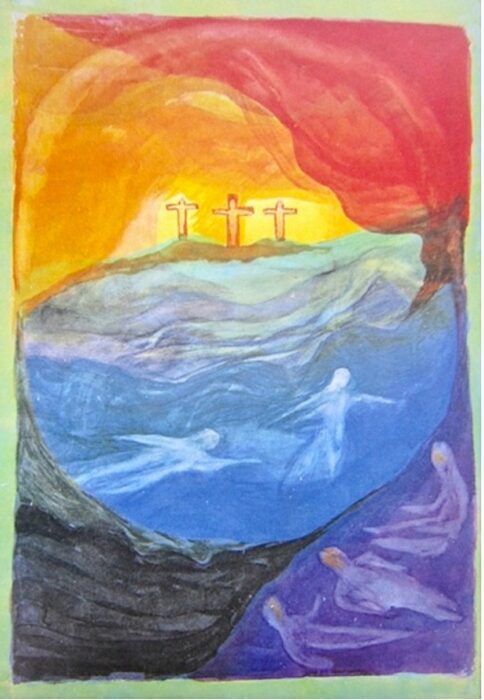
Note: The Act of Consecration of Man is the communion service of The Christian Community. Find out more about what this means.
References
Emil Bock, Three Years: The Life of Christ between Baptism and Ascension
Feature image: Three Crosses, © Fiona Campbell April 2025
 Painted Space